Category Archives for Resources

Content Repurposing Motivation with Example

​Content Repurposing Motivation with Example

Whenever I make a piece of content, I immediately distribute it further and often quickly repurpose into something else. OR I delegate the responsibility to someone else, so I don't forget.

Let me show you what I mean by example...

  1. ​I had a customer who wanted help with something. I said okay, let's talk on a Facebook Live, so my members can benefit too.
  2. The live video takes place in our Facebook Group, so my members can watch me wrestle with technology again haha...and can benefit from the chat as well. If you're going to watch it, start at the 4:57 mark to skip the fluff. 
  3. ​We cut the technology wrestling part out and posted it to YouTube.
  4. ​That YouTube video is also being added to our Insider's Club members area.
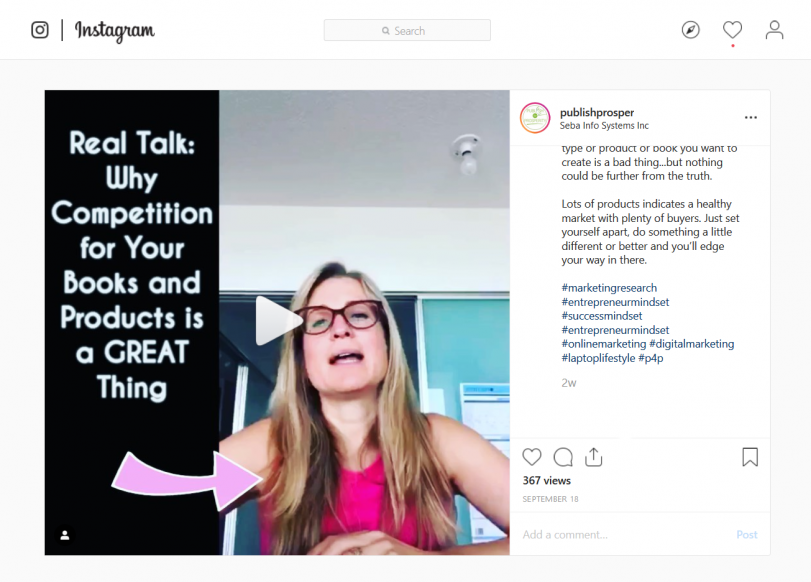
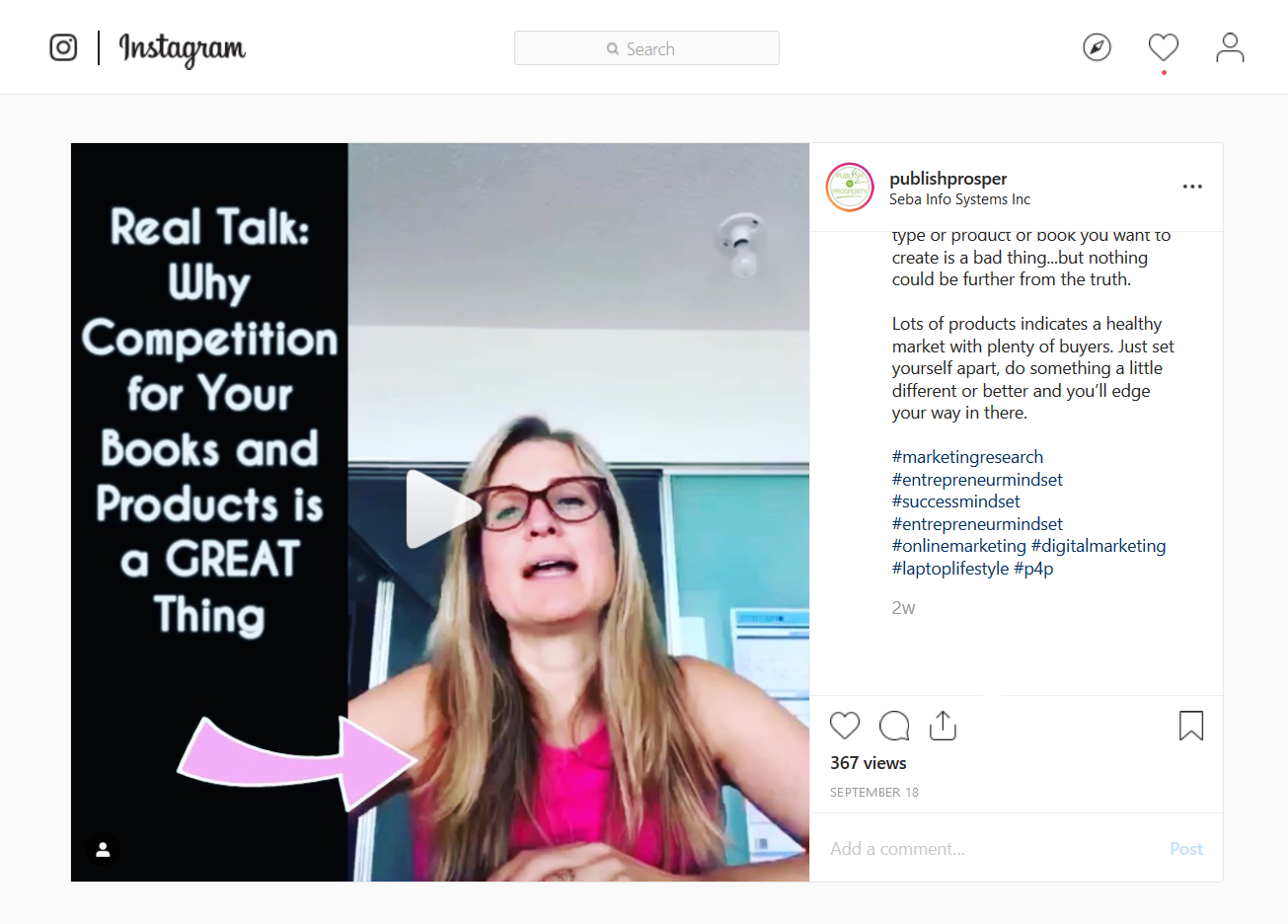
  5. I made a quick clip from the video that I thought had a pretty important point. I added some text to the video to grab some attention and posted it to Instagram, Facebook and Twitter. You can see a screenshot below and the Instagram post directly right here.

And bonus tip: In the Instagram post, I tagged my personal account and set the location of the post as my business, so the content is shown on my profile and for my business name. 

There's potential for several other clips as well, but I think that's good for one day. I'll just take some notes on the other clips and hire someone to do the rest if I decide to move forward.

​It's THAT simple. A customer asks for help and I've got TONS of content.

But there are so many opportunities to repurpose content in your day. Here are just a few:

  • Break up a report into articles or snippets. Add them to your blog and social media.
  • Use your social media quotes graphics in your newsletters, books and relevant blog posts.
  • Bundle up articles into reports or create an autoresponder series.
  • Find quotes from articles and reports that you can turn into graphics.
  • Publish all your content across a variety of platforms and remember to leverage fully and share those links frequently. 

Now if you want some content to get the repurposing process rolling, we've got it...

Help with Your Implementation: We've Got Free Content You Can Use

Put what you learned into practice with some of our free content samples. These samples come with complete private label rights, which means you can edit, brand, monetize and publish the content as your own. 

We've got reports, graphics, articles and all kinds of great content for you to practice with. Use them as is, break them up into bite-sized chunks and share them wherever you publish content. Don't forget to brand and monetize with your product promotions! 

To your great success,
Alice Seba
Alice Seba
Your Partner in Easy Product Creation

Join me, any my special guest instructor, Justin Popovic from Tools For Motivation.
In this session, you will learn insider information on how some of the most savvy business owners are turning done-for-you (PLR) content into a steady flow of revenue generating products/courses.
Justin will also share some real-world, practical examples of how PLR content can help you…
* Build the know, like, trust factor to make selling your offers a breeze.
* Spoil your subscribers so they never want to leave your list… while turning them into repeat customers
* Create a WOW factor for new people visiting your site for the first time by creating free blog posts that you “COULD” charge money for… and do so in less than 10 minute
* Gain a huge competitive edge by creating visually stunning ebooks, presentations, handouts and more… even if your design skills suck
Save Time And Make More Money In Your Business Using Done-For-You Content

How to Get Rid of Your Anxiety-Inducing Mind Clutter

How to Get Rid of Your
Anxiety-Inducing Mind Clutter

What we think becomes our reality and unfortunately, we are often our worst critics. All these stories we tell ourselves become clutter in our minds and keep us from achieving what we want.

I’m Alice Seba from Publish for Prosperity and through working with my clients and customers over the past 16 years, I’ve seen this firsthand many times, but luckily I’ve got some tips to help you get rid of that anxiety-inducing mind clutter.

Here's an Excerpt from Our Minimize to Maximize Training That Addresses This Issue…

Now let’s look at what’s going on in our minds. Earlier in the training, we touched on our love affair with stuff. The more stuff we have, the more responsibility we have and the more our mind is cluttered with the stuff we have to do.

Same with the expectations we’ve allowed society to place on us. That we should be married. That we should have kids. That we should…whatever.

Add to that, we allow our minds to be cluttered with the stories we tell ourselves. Your thoughts take control over you and keep you from achieving what you really want to achieve.

I've always been an overthinker. And even now, I still am…and it has its benefits. It enhances my creativity, allows me to be empathetic to others and keeps me from being too impulsive…which is one of my weaknesses too.

But I've made sure that all these thoughts don’t hold me back from achieving what I want to achieve.

I let all those thoughts come in and then…I let them go.

I see them for what they are.

Sometimes they are insightful thoughts that help me move forward.

Sometimes they are made up stories that have no basis in reality…although in the past I would have believed they did.

Because in reality, I can do anything I want and I can be as successful as I want. It’s only the stories I tell myself or the stories I believe from others that keep me from getting to where I want to be.

Same with you. What stories do you tell yourself?

• That you’re not as smart as other people?
• That you’re not as good looking?
• That you’re not good with money?
• That you’re not very organized?
• That you can’t lose weight?
• That you aren’t cut out to be an entrepreneur?

All those things you tell you become your reality. So stop telling yourself those stories and switch them to positive things instead. And even if you can’t say “I’m good with money” At least tell yourself, “I’m learning to manage money and I’m making improvements every day.”

And of course, not all these positive stories are going to work on their own. Yes, if you tell yourself you’re smart or good looking…over time, you will build that self-confidence. But if you say you’re getting better with money, you better darned well put the work in for it.

Because that’s going to be key here. I’m sharing all kinds of ways to change your mindset and that is a HUGE part of the battle, but you’ve got to do the work. Develop the good habits. Get back on the wagon when you fall off and be ready to keep focused.

What to Do Next: ​Minimize to Maximize Your Life and Your Client's Lives Too

This video is just a small excerpt from a Q&A session of our ​Minimize to Maximize Your Life subject matter expert training, where we not only show you how to simplify your life for more contentment and success...but we also train you, so that you can teach the method to your own customers. 

We've created all the training ​materials for you. All you have to do is ​​listen to a few training sessions, so you can be the subject matter expert and confidently deliver this high ticket training program to your students. Or if you don't want to deliver the training yourself, you can use the recordings, transcripts and notes from our training and turn that into an instant online course for your customers. 

It’s a super easy way to get immersed in selling high-ticket training products…without having to do all the hard work. 

The coupon code above will save you ​$40​ on ​any of our ​single payment options and is the perfect way to get started in learning a ​way to stop cluttering your life stress and get to success much faster...AND allow you to share that same system with your clients and customers, creating your own high ticket training program in the process. Click here to get started

We look forward to having you join us. 

To your great success,
Alice Seba
Alice Seba
Your Partner in Easy Product Creation

How to Get Your Children Involved in Their Personal Development

Inspire Your Child to Choose the Right Path for Their Future…without Being an Overbearing Parent

We all want the best for our children, but often don't realize the limiting ideas we unconsciously pass onto them. Instead, taking a more proactive and conscious approach…without becoming an overbearing or demanding parent…will help our children develop the mindset that empowers them to create the best future possible for them. 

Here's a Question from Our 4X System Subject Matter Expert Training Q&A Session:

How do you get your children involved in their own personal development?

4X System creator, Damon Greene, talked to us about his experience of getting his children involved in their own personal development. His son has published a book and sold products on Amazon, all while attending college full time. His son is exploring his career and entrepreneurial paths because Damon presented with him possibilities and gave him the resources to change his own mindset. 

Some of what Damon does for his children:

  • Exposing them to people who have accomplished goals his children may want to achieve
  • Gives them resources that have helped him and that can help change their mindset
  • Became more conscious of the self-limiting beliefs he passed onto his children and correcting them
  • Being proactive and being involved, while still allowing them to make their own decisions

Watch the video above to learn more about how Damon did this. 

As he told us, “You can only teach your children what you know,” but we have to consciously pass those positive lessons on or we may be surprised at how our unconscious messages come across. 

What to Do Next: Learn the 4X System and Use it to Help Your Clients and Customers

This video is just a small excerpt from a Q&A session of our 4X System: Achieve Goals You Never Thought Possible 4X Faster subject matter expert training, where we not only show you how to get more done in less time...but we also train you, so that you can teach the method to your own customers.

We've created all the training and marketing materials for you. All you have to do is join us for a few training sessions, so you can be the subject matter expert and confidently deliver this high ticket training program to your students. 

It’s a super easy way to get immersed in selling high-ticket training products…without having to do all the hard work. 

The coupon code above will save you $20 and is the perfect way to get started in learning a system that will help you achieve your goals 4 times faster...AND allow you to share that same system with your clients and customers, creating your own high ticket training program in the process. Click here to get started

We look forward to having you join us. 

To your great success,

Alice Seba and Damon Greene
Your Partners in Easy Product Creation

How to Find and Work with an Accountability Partner

6 Questions to Ask Yourself When Finding and Working with an Accountability Partner

If you or your clients struggle with getting more things done and accomplishing important goals in your life, having an accountability partner or group make a world of different, but there are some ins and outs to setting it up right. 

Here's a Question from Our 4X System Subject Matter Expert Training Q&A Session:

How do I find an effectively work with an accountability partner or group?

It's a great question and if you've never formalized the accountability process for yourself, it's much more difficult to stay on track. Watch the video above for 6 questions you should ask yourself or ones you should get your clients to ask themselves when finding an accountability partner or group. 

Here is a list of the 6 questions you need to ask yourself, but watch the video to get the full explanation, examples and implementation strategies:

  1. Do You Get Along and Have Something to Offer Each Other?
  2. Are You Both Moving Toward Something?
  3. Are They (And Are YOU) Reliable?
  4. Can You Make it a Habit? (this is key and you'll find strategies  in the video)
  5. What's Your Preferred Method for Communicating?
  6. How Can You Document the Process So it Helps Everyone?

When you regularly check in with someone and they call you out when you're messing things up, it's much easier to stay focused and on track with your goals. You'll eliminate distractions, stay productive and have a chance to learn from each other's experiences. 

To your great success,

Alice Seba and Damon Greene
Your Partners in Easy Product Creation

Letting Go of Perfection for Bigger Profits

Letting Go of Perfection for Bigger Profits from Your Information Products and Training Programs

Let Go of Perfection

by Alice Seba
Owner PublishforProsperity and
Done-for-You Content Provider Since 2006

After working with information product and online course creators and hopeful product creators for over 15 years, there is one thing that holds people back from success than any other.

That is the need for perfection. The need to perfectly understand the process before starting. The need to have a perfect product before launching.

But calling it perfection is a lie.

Perfection sounds like a positive thing and people hide behind the words, “I'm a perfectionist.”

But perfection is just an extremely misleading word for procrastination.

The desire for perfection boils down to excuse after excuse for not getting stuff done.

If you want to be successful creating information products, training programs or in any business at all, it's time to let go of the false idea of perfection.

Here are a few ways you can do that…

1. You Don't Need to Know How to Do Everything before You Start

If you've been telling yourself that you'll launch your first product once you figure out A, B, C and D…you're giving yourself the biggest excuse ever to do nothing at all.

Think about all the things you've done in your life without knowing exactly where you're going. Whether it was to learn to drive, cook a meal, get married or even have a child, most of us jump in and learn as we go. We make mistakes and sometimes screw up royally, but all those are lessons for us to improve or get it right the next time.

You do not need to know who your web host will be, how you'll create your site, what autoresponder you'll use or what platform you'll sell your product with…and know each step of all those things before you begin. You'll do them and learn them as you go.

So many people I speak to want a precise blueprint and want every step outlined…but there really is no such blueprint because there are many variables that decide how you'll execute your plan. It could be your budget, personal preferences, your target market or just about anything else.

If you're looking for a cookie cutter approach to what you should do…you'll get cookie cutter results. But if you can learn what's best for your business as you go and adapt as you make be discoveries, you'll have much more success.

Which brings me to the next point…

2. Be Willing to Adjust Your Plan

Just like you might change the steps you follow or the software you use to launch your product, you need to be flexible with the product itself.

When we start, we have these grand ideas of our perfect product. But then we get down to work, we realize that it's going to take forever to get where we hoped.

That's the point where the deadline you set for yourself is more important than perfection. For accountability, tell your subscribers your product will launch on a certain day and make sure you deliver. That might mean changing your expectations of what the product will look like, but it's better than waiting until NEVER to launch. 🙁 

Because here's the thing…

3. Don't Assume You Know What “Perfection” Means to Others

We all have this idea of what our ideal product should like, so we get married to the idea and it's hard to let go…but realize that you have no idea of what perfection looks like to your customers.

And the only way for you to really discover that is by getting content out to them and letting them tell you what else they need…and then providing it to them.

Why spend months or even years creating something, only to discover you were missing what your customers really needed?

Just let go. Let your customers surprise you and tell you what they need.

And yes, you could survey your followers before you release your product…but then you're getting the feedback of people who simply say they're interested. You want feedback from people who have already committed and paid you, so you know how to serve your actual customers better.

And speaking of others, this product creation game doesn't need to be…and shouldn't be…a solitary activity…

4. Let Others Help You

I was overwhelmed by things just like you. All the tasks I had to complete and learn how to do. All the content I had to create. And I had to do it all because it had to be perfect.

But that thinking was wrong for a couple of reasons:

There are far more talented and knowledgeable people than I am…so it's silly for me to try to retain full control of each part of the process.

I only have so much time in the day. If I'm trying to do everything, things are going to slip through the cracks. And from my experience with creating products, people get most bogged down in the creation process and they skimp on the selling and marketing part…and really cheat themselves in creating a best selling product.

The moment I started to let go and to accept help, the faster my success came. I hired writers and used private label rights content. I hired people to do my graphics and so on.

Then I was able to focus on selling my product and making it a financial success. Because after all, we create products because we want to help people…but if we can't sell them, how are we going to get them out to those people?

Free Smart Goals Worksheet

Free Downloadable S.M.A.R.T. Goals
Worksheet with Private Label Rights:

Stop Talking about Your Goals Like They're Dreams…Get ‘Em Done Instead

A Goal without a Plan is Just a Wish

The other day, we shared our free Time Calculator that helps you discover just how much time you have to pursue new goals and achieve those things you've been putting off forever. Well, now that you know you DO have the time to work on the things that matter to you, let's get to working on getting to those goals.

You've probably heard of S.M.A.R.T goals before…and that's because it's a formula that works. Here's an overview:

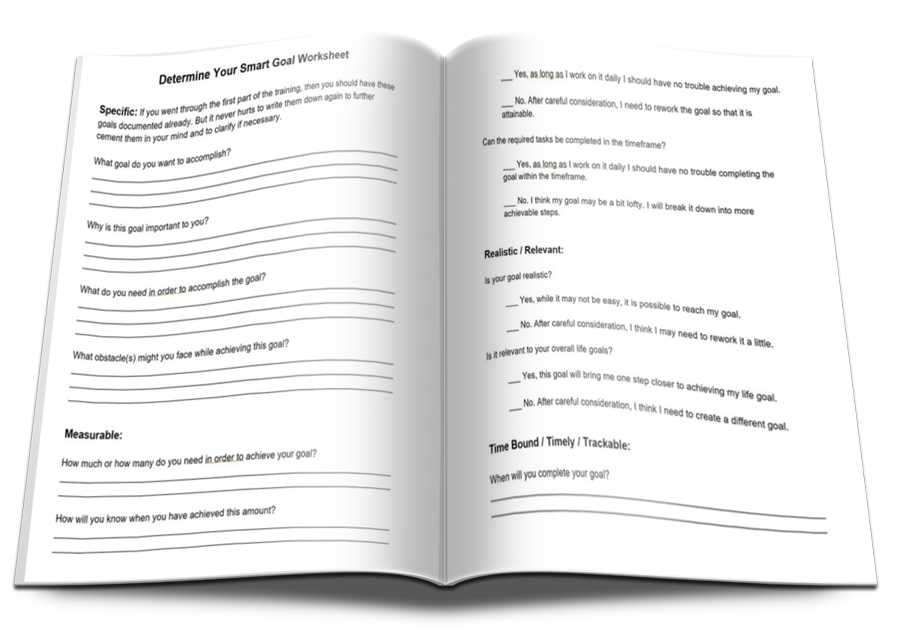
Smart Goals WorksheetSPECIFIC – Your goal needs to be spelled out very precisely and you also need to have a reason WHY behind your goal…some benefit or emotional attachment that will keep you focused. For example, a goal might be to earn $12,500 per month and onboard 5 new quality clients monthly in the next 90 days.

Using language that leaves no doubt as to what the goal is, why you want to achieve the goal, and how you will get there is very important. If you are not able to be detailed in your description of the goal, it will be hard to meet it. Take the time to do this part right.

MEASURABLE –  If your goal cannot be quantified, then it’s not a full goal and you won’t know how when you have succeeded. An example of a measurable goal would be “I want to deposit to our bank account an additional 100 dollars per week. I’ll accomplish this by writing five 500-word articles each week for a life coach.”

This is where journaling comes into play. It’s a report card and a method to measure what you want to accomplish and what you actually accomplished. And our 4X System Level-Up journal actually walks you through that and helps you achieve your goals 4 times faster. 

ACTIONABLE / ACHIEVABLE – There are different things that “A” can stand for, but it’s usually actionable or achievable. In order to achieve anything, you must take action. So, make your goal actionable, where you do something each day that will eventually result in an accomplished goal.

Goals should also be achievable or you will quickly get frustrated. Be accurate about the time it takes to reach a goal, and what actions it takes to get there. Also, know who will be responsible for doing it.

REALISTIC / RELEVANT – “R” can stand for realistic or relevant, and both are important. If you want your goal to succeed, it should most certainly be realistic or you will fail. If you’re currently making $500 a week and your goal is to increase that to $12,500 in 90 days, that’s not realistic. However, you may be able to increase it by $300. Once you achieve that goal and are earning $800 a week, you can set a new goal to increase your income by another $500 a week or something similar.

Your goal should also be relevant to your life’s vision and match your values. There’s no point in making or achieving goals that have no relevance to your long-term life goals. You could instead use that time to reach goals that get you one step closer to actually reaching your life goals. So always ask yourself, if the goal is relevant to your life goals.

TIME BOUND / TIMELY / TRACKABLE – Various authors refer to the “T” in the S.M.A.R.T. acronym as time-bound, timely or trackable. All of these t’s are important parts of the goal creating and setting process. If you don’t set a time limit and you can’t track what is happening, your goal will be hard to quantified or show as achieved.

To help you and your audience work through and create S.M.A.R.T. goals, download the quick guide and worksheet below. Of course, planning your goals is just the beginning to achieving them. From here, you'll need to implement your plans and come up with an approach that allows you to get their faster and stay motivated, which is what we do in the complete 4X System: Achieve Goals You Never Thought Possible 4X Faster training.

Download Your Free S.M.A.R.T Goals Worksheet with Private Label Rights Here (zip)

You can use the worksheet for yourself or share it with your subscribers and customers. It comes with private label rights, which means you can brand it and distribute it. We've included instructions and a copy of this blog post, so you can easily share it with your audience too. 

Free Download: High-Ticket Online Training Program Planning Checklist

Free Download: High-Ticket Online Training Program Planning Checklist

High Ticket Training Program Checklist

If you’re planning to launch your own online training program, it’s important to plan out your content, so that you have the best student experience possible. The more you can add interactivity and practical applications, the more you’ll be able to charge for your training and the more likely your satisfied students are to recommend you to others.

To help you out, we've created a checklist focuses on providing the high-level experience for your students, so in turn, can sell your offer at a high ticket price.

Download Your Free Checklist Here (PDF)

As we mentioned the other day, the opportunity to sell information and turn it into a living online is immense (Global Industry Analysts projects it to be a $241 billion industry by 2022). If you're not cashing on this, you are missing out on a highly lucrative way to generate an income with very little cost to get started.

What to Do Next:

We've got the training you need to set up a high-ticket training product that teaches your students to finally get organized, productive and achieving goals they never thought possible. We've created all the training and marketing materials. All you have to do is join us for a few training sessions, so you can be the subject matter expert and confidently deliver the training to your students. 

To serve you best, would you answer these 3 quick questions and we'll even give you a $​50 off coupon to thank you for your time?

It’s a super easy way to get immersed in selling high-ticket training products…without having to do all the hard work. The survey will only take a moment and will allow us to create the best training program for you possible. 

Lessons Learned from Creating High Ticket Training Programs

4 Income-Boosting Lessons Learned from Creating High Ticket Training Programs

Lessons Learned from Selling High Ticket Products

by Alice Seba
Owner PublishforProsperity and
Done-for-You Content Provider Since 2006

The opportunity to sell information and turn it into a living online is immense (Global Industry Analysts projects it to be a $241 billion industry by 2022). All we have to do is look at marketplaces like Kindle, ClickBank, Udemy and others like it to see online teaching is a booming business.

Now when you think of those platforms, we see many different price points. On Kindle, you can get information for as little as 99 cents or even for free. And of course, marketplaces like ClickBank and Udemy offer products at a wide variety of price points.

And the reason is simple. All price points work, but there is something to be said about high ticket programs. I've been selling products at a wide variety of price points and I always come back to high ticket items because they boost my business greatly.

If you're thinking of getting into high ticket online courses, here are 4 lessons I've learned that I think you'll find helpful too.

#1:  Your Happy Customers Want More

Selling lower ticket items is a great model and absolutely nothing to sneeze at. Most of my products are low ticket. It's an easy way to get a lot of the customers through the door and give them a taste of what you have to offer. Of course, since you're delivering stellar content and guidance, they're going to want more and the more they already enjoy your material, the more willing they'll be to invest larger amounts into their education with you. 

In short, your happy customers want more, so give it to them! 

#2: You Have to Sell Less to Make More 

This is a simple math equation, but in addition to having to sell less to make more, it's often easier to sell a higher ticket product. When you sell low ticket products, you always have to make up for it in volume. If you have the list, advertising dollars or affiliates to help you do that, it's certainly doable. 

When you only have to sell 10 products at $197 to make $1,970...that seems a whole lot more doable than 115 sales at $17, doesn't it?

#3: Make it As Easy as Possible

So how do you differentiate between a $17 and a $197 product? How do you convince your customers it's worth the investment?

Well, there are a lot of techniques you can employ, but one thing you should focus on is making participating in your program as easy as possible. What can you do to get them to results with the least effort possible? Nobody wants things difficult, so figure out what you can do to do some of the work for them. 

Here are 3 ideas to get you started:

Include Templates: If you're teaching them to reduce their debt, make budgeting templates, fill-in-the-blanks letters to creditors or whatever they need to accomplish the goals for your course. 

Add Interaction: Making your course interactive provides built-in accountability and they're more likely to take action. Whether it's talking with you about their progress or participating in a community related to your program, when your student feels like they have someone waiting for them to take the appropriate steps, they are more likely to take them. 

Do Some of the Work: Offer done-for-you components, where applicable...and charge a premium for them. If you're offering a weight loss program, offer custom menus or exercise plans. Depending on how much you're already charging for the program, these extra services might be at a higher membership level or can be offered as an upsell. 

#4: High Ticket Customers are AWESOME!

Talk to anyone who has sold high and low ticket products and they'll tell you their high ticket customers are almost always more easy going. Oddly enough, people who pay less often have higher expectations, are less patient with any issues that may come up and can be a royal pain in the butt. Obviously, that's not everyone...but it's a generality that always seems to ring true. 

It's likely because the people who are willing to pay more also see greater value in what they purchase. Someone who is only willing to pay $17 for your expertise doesn't really value it...and they're more likely to have higher, and often unrealistic, expectations. 

In short, selling higher ticket products can make your life a whole lot easier and your business much more lucrative. 

PROFIT: Strategies for Turning Your Mailing List into a Long-Term Profitable Asset

Simple Strategies for Turning Your Mailing List into a Long-Term Profitable Asset
FOCUS: Profiting from Your List

Profit Puzzle SolvedA mailing list is one of your businesses most valuable assets…if not THE most valuable. But it's not simply a matter of getting subscribers and then emailing them. You need a strategy.

We've got some time-tested and true strategies for you below. It's all a matter of getting to know your subscribers and getting them to trust you enough to follow your suggestions. 

And if you still need to build your subscriber list…or just want more subscribers who can't wait to buy your stuff, join us for the training here

#1: Train Your List:

If you want your list to accept and take action on your promotions, teach them to be  accustomed to promotions.

In the privacy note below your subscription box, write something like: “We will only use your email address to communicate with your regarding [x]-related topics and offers.”

BAM – You’ve told them you’ll be giving them offers.

If you want, you can also remind them in your welcome email that you’ll be sending them offers. You can tell them how you like to do review products on your reader’s behalf and alert them to any products that might be helpful or to stay away from.

Again – Now they know you’re going to send them promotions. They can unsubscribe right away if they’re not happy with that.

Then, most importantly, regularly send them offers so they expect them. Don’t hide behind the excuse, “I only have 100 people on my list so I haven’t sold anything to them yet?”

WHAT? Again, your list is made up INDIVIDUALS. Whether it is 100 individuals, 2398 individuals or 100,000 individuals, doesn’t matter. Every member of your list needs to be accustomed to the way you sell to them.

Imagine, if you decided you were going to wait until you hit 1000 subscribers before you sent a promo. That means the first 999 people on your list will be receiving no promotions for a period of time. That is NOT how to train your list to expect promotions. Do it from the beginning.

#2: Get to Know Your Subscribers

I mean REALLY get to know them. No, you’re not taking them to dinner, but still getting to know them. Here’s how:

  • Pay attention to which links they click on in your emails (and track your links!). Whether they are clicking to read/view content, take a product recommendation or sign up for more information, pay attention.
  • Take note of which types of products they are buying through your links.  Note which products flop and which seem to get a lot of response.
  • Invite them to submit feedback on your blog on a certain topic. The response you get can be incredibly valuable and give you insight into your readers.
  • When your readers do comment on your blog, take the time to click through to their websites. See what they are talking about, what their problems are, what products they are buying. Do this on a regular basis and you’ll come to understand your typical audience even further.
  • Survey Them: Now, I think surveys do have their place, but never rely on this alone. I think taking note of BEHAVIOUR is far more powerful. When you create a survey, people get to answer how they THINK they will behave or how you want them to answer . Thing is, people often behave in ways that are very different from how they say they will / do behave.

#3: Don’t Forget Your Thank You Page

Your thank you page is a priceless piece of real estate, so use it! I'm not sure what it is, but people seem to like to follow directions when they hit a thank you page. When someone hits your sign up thank you page, don't waste that space. Offer them a product, a discount, free trial or show them another part of your site you'd like them to see.

#4: Subject Lines Matter

If your emails are top notch, your subscribers will be waiting for them, but this doesn't mean you can get away with dull subject lines.

“Newsletter #18, Volume 8, Issue 1”

...doesn't cut it.

YAWN!

The only job of a subject line is to get your reader to open the email...that's it, so I personally don't really need descriptive subject lines either.

Let’s say we’re selling a potty training guide. I wouldn’t use a subject line like:

"Potty Training Guide"

Sure, it does mean that you're more likely to have those readers ALREADY interested in a potty training guide open your email, but most of your readers won't know (yet) that they really want a potty training guide.

It is the body of your email whose job it is to convince your readers they need a guide...not your subject line. Again, you only need your subject line to get your reader to open the email.

In a case like this, I'd use something like:

"This will help with the frustration..."

Now in this case, if your readers are parents of toddlers, they can very likely relate to frustration and the subject line is more likely to capture interest. Being a parent is a joy, but there are definitely frustrations with all kinds of things along the way.

So, they open the email and you talk about and relate to that frustration...and then they feel like someone understands them, knows what they need and are more likely to make the purchase.

#5: Call to Action Each Time

To further train your list to do what you want them to do, make a goal to have a call to action on each and every email. That doesn't mean you have to send them to buy something each time, but ask them to do something.

Some calls to action can include to:

  • Click a link to read a blog entry
  • Click a link to complete a survey or to leave a comment
  • Click a link to read an informative article
  • Click a link to claim a freebie
  • Click a link to read a review
  • Click a link to enter a sweepstakes
  • Click a link to read a sales page
  • Check their email on Tuesday, for example, as you'll be sending another email with further information on a topic, product, etc.

#6: Email Your Customers

It’s always surprising the number of people who sell products through PayPal buttons and never bother to collect the emails of their customers.

Here’s the thing, your CUSTOMER list is even more valuable to you than your SUBSCRIBER list…and you probably know why.

It’s because your customers have shown that they are willing to open up their wallets and buy something from you. Add to that, if they enjoyed your product and customer service, they are much more likely to buy from you again.

Someone who is a subscriber and simply a prospect, can potentially be a customer…but you are more likely to get positive results from an already satisfied customer.

So start treating your customers differently from your prospects. Make special offers, discounts, etc. for them or allow them to purchase products before anyone else.

A little TLC goes a long way.

Strategies for Turning Your Mailing List into a Long-Term Profitable Asset

Simple Strategies for Turning Your Mailing List into a Long-Term Profitable Asset
FOCUS: 7 Strategies Nurturing Your List

Email Subject Line IdeasTo turn your list into a long-term asset, you’ve got to really understand your subscribers and deliver value consistently.

But make no mistake – delivering value doesn’t mean knocking yourself out silly with work. Use the tips in this post to build a strong rapport with your audience, all the while keeping things as simple as possible.

And if you still need to build your subscriber list…or just want more subscribers who can't wait to buy your stuff, join us for the training here

#1: Write Simple Emails:

Your email writing efforts needn’t be complicated. In fact, in my experience they should be kept really quite SIMPLE because it’s easier and because your more likely to get more results. If you’re busting your butt trying to publish a full-blown weekly newsletter, really consider giving yourself a break.

Think of it this way. People are busy and with few exceptions, experience email overload. Why load them up even more?

Keep your messages short, simple and focused on one thing or a couple things at a time. This allows your readers to quickly absorb your message and decide whether or not to take action on your call to action.

Many people think that if they offer more content, more sections, etc…they are more likely to provide something that appeals to more subscribers. But from our experience (and from the reports of many others), MOST of your readers aren’t reading past the first section of your ezine anyway. The lower down the content appeared in my, the less people took action on what you want them to do. Whether it was to a click a link for information or to buy a product, if the information isn’t in the first section, the response tends to diminish.

Why work so hard if very few people are paying attention?

Overall, you want your readers to be trained to respond to your calls to action. And if you’re just adding extra stuff hoping to capture a few extra people, I suggest cutting out the fat and putting more effort into that first section.

#2: Keep Your Writing “Personal” 

Email is personal communication. It’s generally one person to another. Follow that model in your marketing.

Imagine yourself writing to one person and use language that you’d use if writing to just one person at a time. Don’t address your readers as a group. For example, “I know many of you…”  Address your subscriber as that one important individual they are. The language is far more powerful.

For example, if you write: “I know many of you are looking for a…”

As opposed to…

“I know you are looking for a…”

Which do you think is more powerful? In the first case, your reader can immediately exclude themselves from the offer because you said “many”. That might not include that particular reader. In the second instance, you are stating it directly to your intended audience.

You may be sending out your email to thousands of people, but each of your subscribers is reading it one by one. Address them that way.

#3: From Line is Important:

Who is your email from? If you want to establish that personal connection and gain trust, the from line should have your personal and full name. You can use your company name if you want to build that reputation, but try to include a personal name with it, if possible.

#4: Keep Your Email Address Consistent:

Emails end up in junk folders or get filtered altogether. It sucks, but it happens.

One way you can curb this is by using a consistent email address for all your mailing list communications and getting your subscribers to whitelist you or add you to their address book.

#5: Email More Often:

Here’s another easy way to get over the obstacle of being afraid to do pure promotional emails. Just email your list with content more often, so when you slip in regular promos…the amount of content they receive in comparison still prevails.

Remember, you don’t have to write big fancy ezines with all kinds of sections and departments, just short simple emails that provide good value to your readers. Basically, instead of bombarding them with a ton of information all at once, you’re now giving it to them in bite-sized chunks.

Of course, you need to test out the volume of email your list can bear, but if you’re providing stellar stuff…I bet they’ll want to hear from you more often.

#6: Research Everything:

Your readers will appreciate your promotions, especially when you take the time to research and review everything thoroughly. In fact, your readers will come to expect you to do a lot of the hard work for them…but don’t worry this work is profitable for you!

If you are known for your research, your readers will wait to see your opinion on something and will want to know what you recommend. It’s a big, but profitable responsibility.

#7: Honesty is the Best Policy

When you do your research, report it in an honest way and that will solidify your reputation with your readers even further.

When you investigate a product, avoid coming back and telling your reader’s it’s the greatest thing since sliced bread…because not everybody eats the same kind of bread.

Sure, you might think the product is really terrific, but break it down for your readers and identify:

  • Who the product is for (ex. beginner rose gardeners only).
  • What problems you personally see the product solving.
  • Any potential drawbacks of the product.

Don’t be afraid to share any constructive negatives because that makes your promotion REAL. For example, you can tell them that the baby stroller you’re recommending doesn’t come with a drink holder, but the other features totally make up for it. Besides, an attachable drink holder can be purchased at very little extra cost.